The term ’emergent language’ has recently gained significant traction in ELT circles. This workshop aimed to help teachers understand and manage the unpredictable language that can arise spontaneously in the classroom. We also explored practical tools to address such language confidently in the moment.
Workshop Part 1: Capture it, shape it, reflect on it…
The Loop Approach
My experiments with this approach in my own Emergent Language Toolkit CPD course have led me to design workshops that also follow its structure.
Originally developed by Tessa Woodward, the ‘loop approach’ is a cycle whereby teachers go through the steps of learning exactly what they will be helping their own learners to do. By experiencing the process themselves and going through each stage in a so-called loop, they encounter potential blocks along the way and work together to solve them. Afterward, they reflect and feed their insights back into their own teaching practice.
Packing the suitcase
The workshop started with my own version of Tony Wright & Rod Bolitho’s suitcase activity, which I had adapted into the PACT Suitcase activity (figure 1).
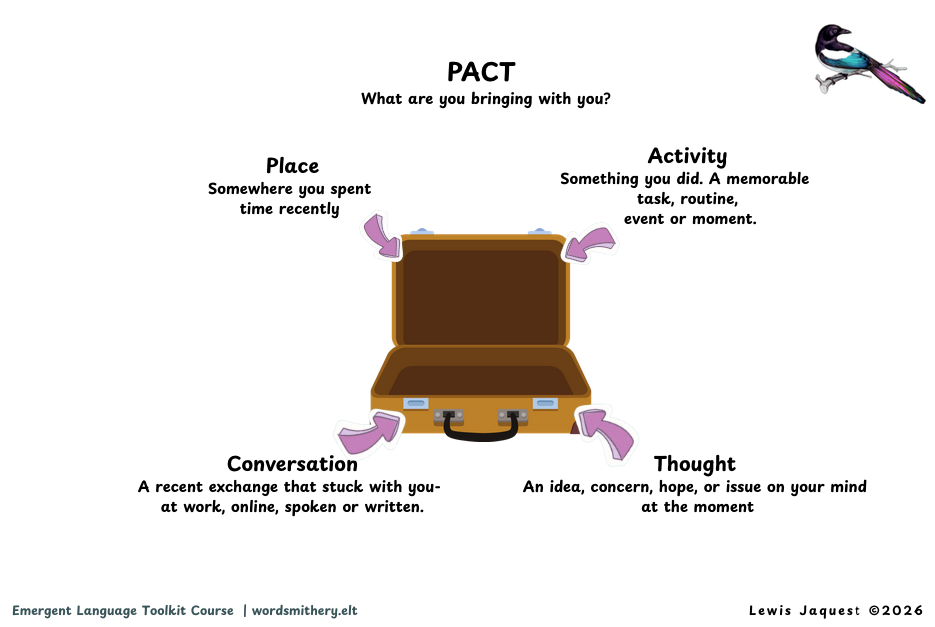
PACT is an acronym which stands for four simple prompts:
- Place
- Activity
- Conversation
- Thought
These prompts encourage learners (or workshops participants) to think about moments, stories, anecdotes and other relevant information from their recent day-to-day lives that they are interested in sharing with each other in breakout rooms.
Collecting the pieces
The teacher’s job then is to collect pieces of language that are emerging. Of course, the workshop participants were all proficient English speakers. Still, the effect and the unscripted moments of language were essentially the same; spontaneous and unplanned language that was being expressed to meet a communicative, meaning-focused need.
These bits of language included chunks, collocations, pieces of functional language (such as clarification requests, offers, agreements) and all sorts of other language, which I collected on an interactive whiteboard as the participants were deep in conversation.
This kind of natural communicative task of course needed to have a clear outcome to make it meaningful: participants had to report back one interesting thing they had found out about their partner and give their partner’s anecdote or story a headline. This meant that they were on task and producing natural streams of language, just as a learner would.
Organising the findings
As the participants filtered back into the main group, I showed them the Flingaboard which I’d been using to collect the utterances and bits of language that had been generated in their conversation.
For those unfamiliar with it, Flingaboard is a free, collaborative whiteboard tool that can be used for collecting, organising and sharing language. It works particularly well with working with language learners online. It’s free to access, requires no sign-ups or logins for participants and allows everyone to work collaboratively (and creatively!!) on the same board.
After getting to grips with the basics of the Flingaboard, we used it as a canvas for participants to organise the pieces of language into groups. While this sorting activity may appear very simple on the surface, it is working at a deeper cognitive level, challenging participants to come up with, justify and explain their reasoning to each other. In doing so, they also need to use a great deal of functional language, all of which can be useful to notice and work with in the language classroom.
Feedback and insights
When the participants fed back on the task and explained the different types of groupings they had come up with for the language that had emerged from the first activity, they also noticed how much incidental language had emerged during the sorting process itself. Through the experiential loop, they recognised that this language could itself provide useful additional material to work with in their own classrooms.
Just as in the Emergent Language Toolkit course and in the Reactive Teaching Practice workshops that I deliver, reflection is an integral part of the learning process and of the learning loop. We therefore closed the first half of the session by reflecting on our initial takeaways, the experience of using the whiteboard to categorise and sort language, and how this could be transferred to our own language learners.
We also surfaced interesting reflections regarding the value of giving learners a cognitive challenge without necessarily having right or wrong answers. This gives learners a sense of autonomy: they are able to make decisions and explain and justify their own answers while still working meaningfully with the language that has emerged. Of course, in the language classroom there will also be upgrades, reformulations and gaps for learners to notice between what they originally uttered and what was subsequently written on the Flingaboard.
The reflection session also prompted explorations of further options of working with this emergent language creatively. By putting some language onto the flingboard in its original, uncorrected form, it could potentially allow learners to work with it, manipulate it and help each other to improve or expand it.
Workshop Part 2: Use it…meaningfully!
Moving into the second part of the workshop, having captured and shaped the language, we then aimed to use and exploit what had already emerged through a number of creative tools from the Emergent Language Toolkit.
I showed participants three possible tools including the wonders of Street View and Story Dice. Participants were tasked with choosing one of these activities and then going away and creatively using some of the language they had collected and categorised from the first task in a productive activity.
Importantly, the task design also meant that they were creating something meaningful to share with the other group afterward.
All groups chose the “Wonders of Street View” task from the toolkit task options (figure 2).
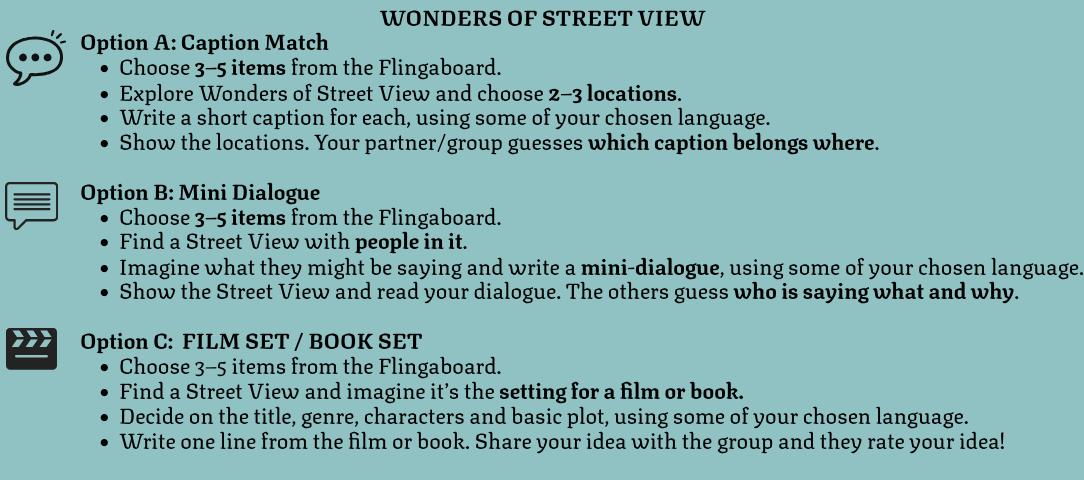
The importance of task design when working with emergent language can’t be underestimated – creating a meaningful gap between learners makes the need to communicate authentic.
As such, the participants had the freedom to choose images from the image bank and then created dialogues, headlines and captions for each using some of the emergent language on the Flingaboard from the initial activity. Reporting back to the main group, the groups had to match the captions to the images with a lot of meaningful communication and equal amounts of laughter ensuing!


Takeaways and participant reflections
We closed the workshop, and indeed the reflective loop, by taking stock of how this kind of activity and design could support learners and promote learner autonomy.
The main takeaways from the workshop were:
- Categorising and sorting tasks for emergent language help learners engage with and process language more deeply.
- Choice and differentiation: Rather than imposing rigid task requirements, we might ask learners to choose between three and five pieces of (emergent) language to incorporate, choose which task to complete, or otherwise give them flexibility in terms of how they complete a task.
- Functional language as a key area: The categorising and sorting tasks in particular prompted the use of a lot of interactional functional language – agreeing, disagreeing, hedging, negotiating, offering, requesting and such more.
- Giving learners choice in the classroom also gives them a sense of agency to self-direct learning.
Final thoughts
This last reflection revealed something which I think is food for thought for any teacher who wants to work more meaningfully with learner-generated (emergent) language.
Letting the learners lead and helping them at the point of need is a skill worth developing. Honing this awareness can be a great help to teachers in making more judicious, on the spot decisions. As Alison King stated, teachers who make more informed decisions as to when they play the role of “the sage on the stage“ and when they relinquish control to be more “the guide on the side“ can give learners much more agency in their own learning.
When learners have the opportunity to select language and make, negotiate and co-construct meaning with it, they are far more likely to engage in deeper processing of language. As a result, they become more self-sufficient learners.
***
Links
Emergent Language Toolkit Professional Development Course: https://wordsmitheryelt.com/
LinkedIn https://www.linkedin.com/in/lewis-jaquest-emergent-language-teaching/
The Wonders of Street View https://neal.fun/wonders-of-street-view/
Story Dice davebirss.com/storydice/index.html
Flingaboard https://flinga.fi/
References and further reading
Wright, T. and Bolitho, R. (2007) Trainer Development. Lulu.com.
Woodward, T. (1988) Loop-input: A set of strategies designed to help language teacher trainers and teachers’ self-help groups to add variety to training sessions. Canterbury: Pilgrims.
King, A. (1993) ‘From Sage on the Stage to Guide on the Side’, College Teaching, 41(1), pp. 30–35. Available at: https://doi.org/10.1080/87567555.1993.9926781