Exploring the science of learning has revitalized and refreshed my take on how I teach and how I prepare for lessons. In this article, I’m sharing three classroom ideas that have worked well for me.
The science of learning explores how people learn most effectively. It covers concepts like retrieval practice, spaced practice, interleaving, and cognitive load theory—ideas now widely discussed in education thanks to authors like James Lang, Pooja Agarwal, and Patrice Bain.
The Art of Starting a Lesson
In ELT, many teachers start a lesson by giving a warmer or a lead-in activity. Alternatively, some prefer chatting with the class, or revising vocabulary from the previous lesson. Others might spend the first few minutes reminding students of upcoming tests or important class rules that some of them have not been following. Another way to begin is by putting an outline of the lesson on the board, and reading it aloud to the class.
All of these are commendable ways of starting a lesson. Yet, I would like to share with you some options you might not have thought of, all of which can have a positive impact on everything that comes afterwards.
1) PRIMING
According to Psychology Today, priming occurs when “exposure to one stimulus influences how a person responds to a subsequent, related stimulus.” In other words, when you see or hear something, it can have an influence on your own behavior, quite often in a subtle unconscious way.
Advertisers and store owners use priming all the time. A wine shop owner might play French music to encourage customers to buy French wine. Or an ad might show a happy family to associate positive emotions with a product.

Priming can also be used to draw attention to course material and prepare students for certain types of learning activities. Trickey (2021) lists several reasons why priming is useful for teachers:
“It reduces anxiety for students who need predictability. It often results in higher achievement in learning. It can be done quickly and with little preparation. It helps students transition from one activity to another.”
Different Types of Priming
Horvath (2019) mentions three types of primes which can be implemented by teachers:
• concept priming
• expectancy priming
• strategy priming
Concept priming is when “specific facts or categories are activated in order to guide how others interpret and comprehend new information.” (Horvath, 2019).
If you plan for your students to read a short article about a trend or current event, you can do some concept priming by presenting background information, or, even better, have them share what they know about the subject in small groups.
Expectancy priming is activating “specific expectations or beliefs in order to guide how others perceive, understand or react to various circumstances.” (Horvath, 2019).
When you show a video to a class, you might employ a bit of expectancy priming by first establishing what they can expect (funny, serious, scary, touching).
Strategy priming concerns “activating a specific procedure or approach to guide how people tackle future tasks.” (Horvath, 2019).
In preparation for a creative project, you might start off with a short brainstorming exercise that will guide students towards thinking more creatively.
A video by SpecTraining (2021) suggests a variety of different stimuli that can be used to prime a class, such as:
- images and video clips
- music and sound effects
- props
It’s vital to use different ways of priming with a class each time, while finding primes that tie in well with the lesson’s objectives.
Horvath (2019) suggests that teachers always anticipate that their prime may not go as intended and have a back-up plan, an alternative route of reaching the intended goal of the original prime.
2) PREDICTING
Another useful technique is predicting. As you might be able to guess, it involves students making a prediction about upcoming course content (a reading text, an audio text, a video, or even an image).
This can be established quite easily by giving them a small portion of the upcoming content, such as the title, the topic or the first sentence. Then, invite students to use their background knowledge to make a prediction.

Mercer and Puchta (2023) state that there are several advantages to prediction activities:
- They engage students and get them to think ahead.
- They activate prior knowledge (schemata).
- Students grow curious about whether their predictions were correct, so they are more attentive to the next section of the lesson.
If students are reading a news article, they can predict vocabulary that will appear in the article, or predict questions that the text will answer.
If they are watching a short video with an interesting plot, you can stop the video several times and ask students to guess what will happen next, then continue the video.
Consider using the think-pair-share format when doing a predicting activity. This format consists of three steps:
- Students make predictions individually in silence.
- They form pairs and reveal their prediction to another student.
- Several students are called on to share their predictions with the whole class.
Lang (2021) suggests using closing predictions, where students make guesses about material they will read for homework, or students make guesses about material that will be covered in the next lesson.
3) PRE-TESTING
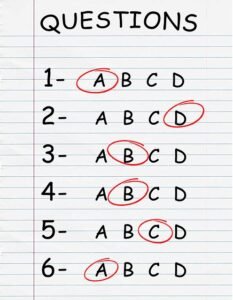
Pre-testing involves students taking a test over material they haven’t encountered yet. The pre-test might cover one part of a lesson (a reading text or a video), or the entire lesson. Pre-tests can also cover material from an entire course.
While a pre-test might seem illogical (why test students on material they haven’t studied yet?), there are some solid reasons for giving one.
First of all, a pre-test gives students a preview of what’s coming next, so they already have an idea of the upcoming content before they start engaging with it. Also, as with predicting, it helps them become more engaged with the upcoming material. Moreover, a pre-test can give students an idea of how much they understand about the subject, and what they need to improve on.
Pre-tests are also used to test content of an entire course, providing a full preview of the course for students. At the same time, they give teachers a clear idea of how much of the material students are already familiar with.
How to Pre-Test Correctly
When planning a pre-test, consider:
- the length of the pre-test
- the points covered
- the format (multiple choice, true or false, short answer, fill-in-the-blanks, or matching)
An important part of pre-testing is making sure that students are given the correct answers, so they can assess how they did on the pre-test. This can be done later on in the lesson, after they have covered the reading or listening exercise.
If you’re worried that announcing a test might raise anxiety, reassure your students that the pre-test won’t be graded.
In summary, no matter whether you choose priming, predicting or pre-testing, they will add a new dimension to your teaching. For more information about these concepts, please consult the titles in the reference section below.
I hope you will consider trying out one of these techniques in a future lesson!
***
If you enjoyed this article, you may also be interested in the following reads:
Unforgettable English Lessons: How to Design Sessions That Stick – Connections
Not Just “What” But “How”: Empower Your Learners With Effective Learning Strategies – Connections
From Speaking Activities to Communicative Performance: 3 Tips to Boost Learner Success – Connections
***
References
Addison, S. (n.d.). Three ways to prime students for learning. Faculty Focus Higher Ed Teaching & Learning. https://www.facultyfocus.com/articles/course-design-ideas/three-ways-to-prime-students-for-learning/
Bower, B. (2012). The hot and cold of priming. Science News, 181(10), 26–29.
Carpenter, S. K., King-Shepard, Q., & Nokes-Malach, T. (2023). The prequestion effect. In C. E. Overson et al. (Eds.), In their own words (pp. 74–82). Society for the Teaching of Psychology.
Horvath, J. C. (2019). Stop talking, start influencing. Exisle Publishing.
Lang, J. M. (2021). Small teaching (2nd ed.). Jossey-Bass.
Mercer, S., & Puchta, H. (2023). Sarah Mercer and Herbert Puchta’s 101 psychological tips. Cambridge University Press.
Pan, S. C., & Carpenter, S. K. (2023). Prequestioning and pretesting effects. Educational Psychology Review.
Woods, T. (2012). Priming. Psychology Today. https://www.psychologytoday.com/us/basics/priming?msockid=3ebde0f55b7761342f25f7db5ae3608f
Science of People (2019). Priming Psychology: How It Works and How to Use It. https://www.scienceofpeople.com/priming-psychology/
SpecTraining. (2022, March 10). How to use priming to improve teaching [Video]. YouTube. https://www.youtube.com/watch?v=VjfHw-jzBLs
Trickey, S. (2021, March 9). Priming. Teach With Mrs T. https://www.teachwithmrst.com/post/priming

Hall Houston
Hall Houston has a Master’s degree in Foreign Language Education from The University of Texas at Austin. In 2016, he completed the TESOL Advanced Practitioner certificate program. In 2023, he completed the Trinity CertPT course. He is the author of several books about language teaching, including The Creative Classroom, Provoking Thought, and 101 EFL Activities for Teaching University Students. His practical articles about language teaching have appeared in publications such as Modern English Teacher, EFL Magazine, TESOL Connections, IH Journal, and MindBrainEd Think Tank. He has delivered presentations and teacher training for Cambridge Assessment and British Council. He currently teaches business English classes in Taipei, Taiwan.