Evan Frendo’s January talk from the “Innovative Teaching Series” at Arden University explored the difference between classroom and corporate settings, as well as the changing landscape of learning and teaching English in an increasingly digitalised and AI-enhanced world.
Corporate priorities
Evan began by noting that language learning is often put on the back burner in corporate contexts. Companies usually place more value on compliance and performance:
English functions as a Business Lingua Franca to communicate and get things done, without interrupting workflows. Learning has to fit that reality (aka LIFOW — Learning In The Flow Of Work).
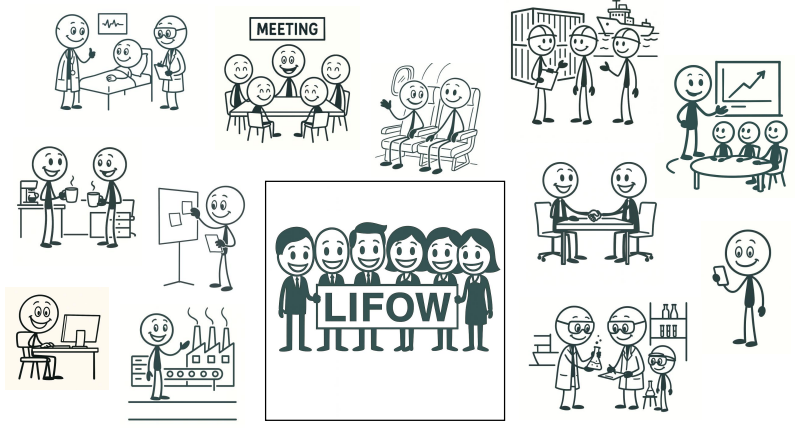
This marks a shift away from traditional models toward more flexible approaches. Learning can range from intentional, structured courses to incidental language use integrated into daily work tasks. Evan elaborated on this, explaining the different types of learning.
Formal and informal types of learning: learners on the spectrum
We discussed the spectrum of formal and informal learning that learners navigate:
On the formal end, there are “traditional” approaches: these are proactive and intentional. Doing a course, learning specific target language or practising key skills are all formal approaches.
On the informal end, there is learning simply through use of language. There is no intention to learn at all – it is simply a byproduct of using the language in everyday life.
In between, on the more formal side, there is explicit learning – being aware of what comes up and practising useful language as needs emerge.
In contrast to that, incidental learning, which means noting something in passing, is a more informal way of learning.
Evan’s main point was that the traditional teacher-centred approach of learning English is making space for more informal and learner-centred ways of learning. One of the reasons for this, besides LIFOW, is the fact that corporate learners have their own communities of practice.
Learners use specific vocabulary at work (their “company speak”). That means that their own experience is often more useful than traditional classroom knowledge. So their learning process is naturally more pragmatic, which lends itself to the task-based approach.
Task-based learning: learning by doing
Evan presented task-based learning as a hands-on way to foster the DIY-mindset in teaching. It has the double benefit of using the target language in a task-related context, so it combines learning and getting real-life work done. At the same time, it is innovative in the sense that there is no prediction of specific language outcomes: the language used will reflect the needs of the learners.
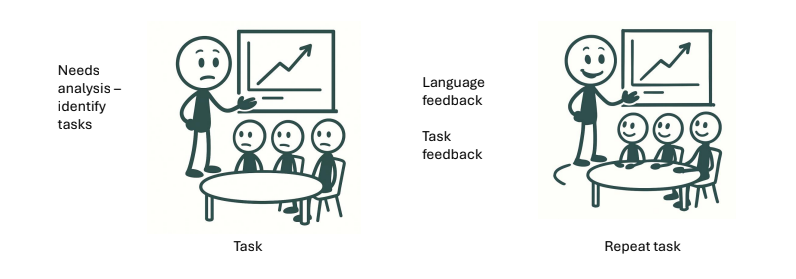
The process follows these steps:
- Needs analysis/identify task
- Task
- Language feedback
- Task feedback
- Repeat task
For this, the trainer engages in on-the-job shadowing, becoming a mentor who reviews activities and encourages reflection. The trainer also guides the process by directing the team and asking questions like “What have you learned?”, which leads learners through an iterative process.
As a result, the teacher’s role shifts from language specialist/walking dictionary to mentor and moderator.
This hands-on approach also reflects broader changes in how teaching and learning are structured.
A new trend: IDLE
While the traditional way of teaching is all about formal teacher-and-book-centred courses, IDLE stands for the highly personalised experience of using digital tools to learn, no teacher required.
Informal Digital Learning of English is:
– just-in-time/delivered as needed
– bite-sized
– accessible
– relevant
– personalised
– integrated into performance.
For some time now, there has been a shift from publisher-led (following coursebooks) to teacher-led (with the teacher combining and editing resources) to student-led (i.e. students designing and curating their learning process in accordance with their needs).
But this is not the only shift that has been occurring:
Enter AI
The biggest recent shift has been the introduction of AI assistants, which can take on most office tasks, such as:
- writing emails
- creating presentations and reports
- visualising workflows, etc.
Newer versions go a step further: they can imitate writing styles (thus helping assistants write in the manager’s name), or provide real-time translation of online team meetings in any language.
As a result, there’s no longer a pressing need to learn a language in order to write emails or understand what’s happening in a meeting. AI can shoulder most of that, saving the company time and money.
However, Evan explained that while AI is good at collecting queries and responses from users, it’s far less effective at evaluating output. As its core function is predicting linguistic patterns, it lacks metacognition and real-life experience – it simply has access to a giant database.
Therefore, it still needs to be monitored by humans to prevent malfunctions and inconsistencies.
The person analysing AI is also called the “human in the loop”, overseeing the process and curating output.
What do these shifts mean for teachers?
As recent trends shift away from traditional teaching toward learner autonomy and increasing digitalisation, how is the role of the teacher changing?
The role of the teacher is rapidly evolving into that of a co-explorer and curator, rather than the sole source of knowledge. Evan predicted that while AI won’t replace teachers as a whole, it might replace those who aren’t AI-savvy.
His advice to teachers was to keep up with the times: to embrace AI to learn to work with it effectively, and to see themselves as “teachers in the loop.”
In a nutshell, teachers should act as learning consultants: counselling, guiding, and supporting the learning process while regularly checking in with their students to ensure they remain on track.
***
If you enjoyed this article, you might also be interested in:
From Tool to Collaborator – How to Turn AI into Your Personal Teaching Assistant – Connections

Sandra is ELTABB's Chair and the current editor of the ELTABB journal. She holds an MA in English and is passionate about brain-friendly language learning and teaching. Likes Shakespeare and Venetian lute music.