Have you ever wondered why some lessons spark real thinking and others drift into passive listening? This article reveals two practical frameworks that can turn classroom energy into lasting learning. Discover how to design lessons that help students think and feel differently by the end.
Think about the most memorable lesson you’ve ever attended. As a teacher or as a learner. What made it stick?
It probably wasn’t the slides. It wasn’t the volume of content covered. Chances are, it was how it felt to be in the room. The moment the trainer asked you to do something: to talk to someone, to make a decision or draw something unexpected. The moment the energy shifted and you stopped just receiving information and started actually thinking.
That question opened the workshop I delivered for ELTAU in May 2026. And the responses in the chat told the whole story. Words like “energetic, storytelling, images, hands-on activities!” This set the scene perfectly for the workshop ahead.
The problem with content-first lesson design
Most of us were taught to design lessons by starting with content. What do the students need to know? Which grammar point are we covering? What vocabulary should they leave with?
More often than not, the result is a lesson structured around delivery. The teacher talks. The students listen. There might be a task at the end. But the learning happens in one direction, from the front of the room outward, and a significant amount of it doesn’t land.
A significant amount of it doesn’t land.
It’s not a knowledge problem. It’s a design problem.
When we understand how the brain actually processes and retains information, we start making different choices. Not bigger choices or harder choices. Small, practical ones that shift where the thinking happens in the room.
Framework One: 6 Principles to Make It Stick
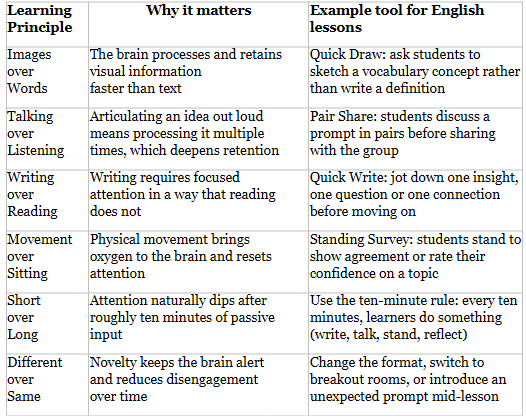
Training from the Back of the Room (TBR) is a methodology developed by Sharon Bowman, grounded in six brain-based learning principles. Each one reflects something we know about how people take in and retain new information. Together, they offer a practical lens for redesigning any lesson, regardless of topic, level or format.
Here’s a brief overview of each principle, with a practical application for English language teaching.
Framework Two: The 4Cs Map
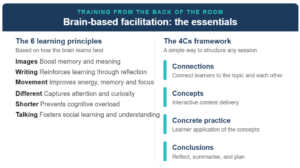
Alongside the six principles, the session introduced a lesson design tool called the 4Cs Map. It offers a brain-friendly structure for planning any lesson or workshop:
- C1 Connections: Start by connecting learners to each other and to the topic. What do they already know? What do they want to find out? This is where you create psychological safety and activate prior knowledge.
- C2 Concepts: Introduce new content in short bursts of ten to twenty minutes, followed by a brief activity to consolidate understanding. This is not a lecture phase. It is a guided exploration with frequent check-ins.
- C3 Concrete Practice: Learners actively apply what they’ve learned. This is where real understanding gets tested and built. Role plays, peer teaching, card sorts, problem-solving tasks. The activity depends on your content. The principle stays the same.
- C4 Conclusions: Give learners time to reflect, summarise and commit to action. A learning log, a top takeaway exercise, or a “Wow and How About” reflection prompt all work well here. The conclusion is not a wrap-up. It is the moment learning moves from the session into long-term memory.
In the workshop, participants used the 4Cs Map to begin designing a lesson of their own in real time, filling in each quadrant as we explored the tools available for each phase. Several teachers shared their plans in the final breakout discussion, and the variety and quality of what they produced in under forty minutes was striking.
That is the shift these frameworks invite. Not a complete overhaul of what you teach, but a rethink of how you design the conditions for learning.
Final thoughts on the frameworks
The six learning principles and the 4Cs Map are not complicated. They don’t require expensive tools or a complete redesign of your materials. What they require is a shift in starting point.
Instead of asking, “What do I need to cover?”, start with, “What do I want my students to be able to do, think or feel differently by the end of this lesson?” That question changes everything that follows.
“What do I want my students to be able to do, think or feel differently by the end of this lesson?”
English language teachers are already skilled communicators and relationship builders. These frameworks give that skill a structure. They move the pressure off you and onto the group, where the learning actually happens.
And don’t just take my word for it, feedback from the session included:
“The 4C’s are an excellent tool for planning and structuring a lesson.” – Markus
“Love the structure and variety – it’s a real mix and match.” – Brigid
“I really liked the facilitation cards that were used throughout the session – I liked that it had a beginning, middle and end. I loved the whole session.” – Vivian
Want to explore further?
If this article has sparked your curiosity, there are three ways to go deeper.
The Unforgettable Facilitation online taster workshop is a practical introduction to the six principles and how to apply them in your own sessions. It runs periodically online and is suitable for teachers, trainers and facilitators at any level. If you missed the workshop, and want to experience them yourself, sign up here.
The Facilitation power hours are 1-2-1 opportunities to create a 4C’s map together on a session you plan together, exploring the principles and the tools that would suit your session plan. Book your slot here.
The next public Training from the Back of the Room Practitioner Course takes place on 19 and 20 November 2026 in London. Over two days, you’ll experience the full methodology, earn a globally recognised practitioner certificate, and leave with a complete session plan built around your own content. Sign up here or express your interest here for bringing TBR to Germany.
You can find further details at Linktree or by connecting with Rachelle Williams on LinkedIn.
***
If you enjoyed this article, you may also like:
Boost your Online Teaching with Brain-Friendly Slides – Here’s How – Connections
Not Just “What” But “How”: Empower Your Learners With Effective Learning Strategies – Connections
Title image by: Manfred Steger, Unsplash